
Story · For families · Foster Care
Why Extracurricular Activities Matter So Much for Kids In Foster Care
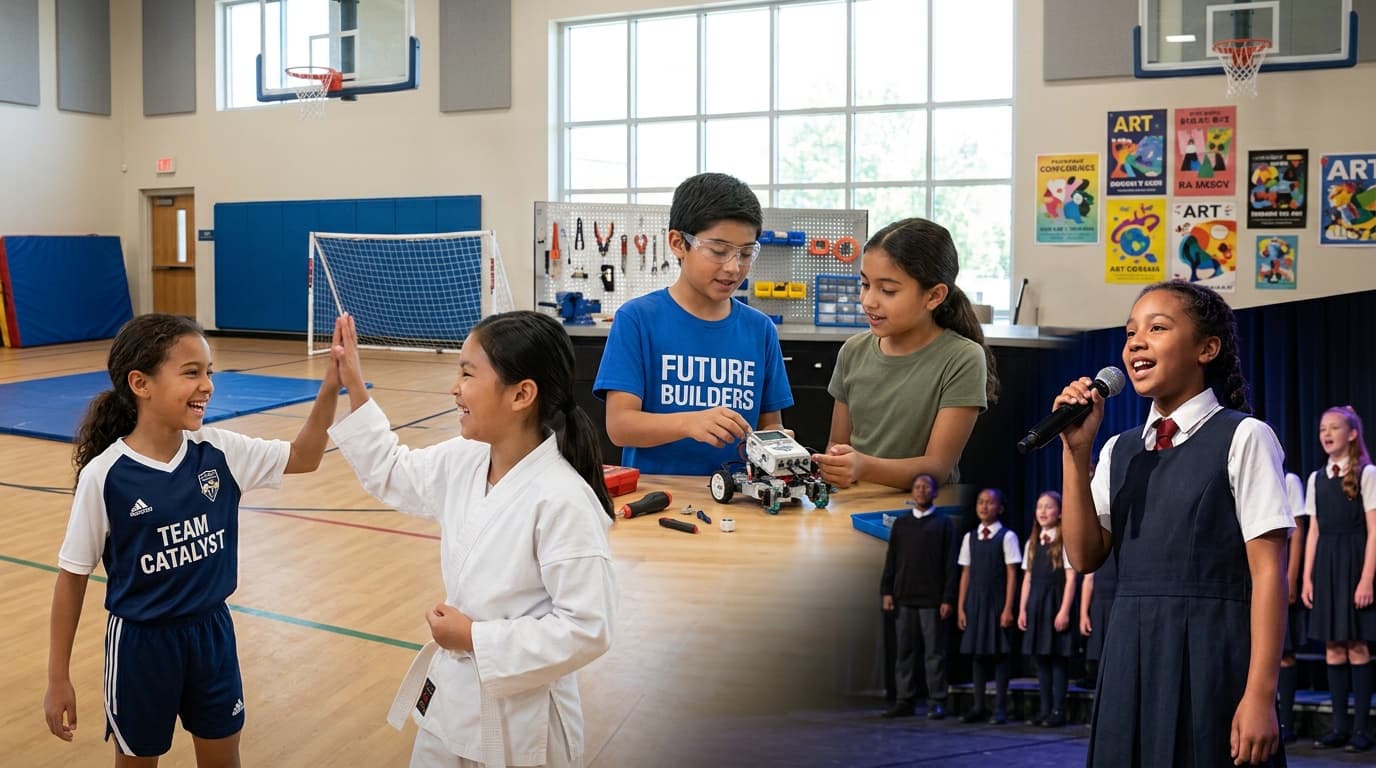
Sports, music, and clubs help every child. For kids in foster care, participation is linked to significantly better odds of graduating high school.
Ask an adult who spent their teenage years in foster care what got them through, and you will hear about a person and a place. A coach. A band director. A gym that smelled the same every Tuesday. Something that stayed the same while everything else moved.
That is not sentiment. It is one of the better-supported findings in child welfare research, and it has a measurable effect on whether a kid finishes high school.
The research: participation is tied to graduating
A study by Scott, White and Munson, following older youth transitioning out of foster care, found that those who participated in extracurricular activities were roughly twice as likely to graduate from high school with a diploma by age 19 than peers who did not participate. Participating youth also reported better grades and higher educational aspirations.
That matters because the baseline is grim. Nationally, students in foster care graduate high school at a rate near 54 to 55 percent, compared with about 86 percent of students overall. Dropout rates run roughly three times higher.
There is better news on the college side than the old statistics suggested. For years the widely repeated figure was that only 3 percent of former foster youth earn a degree. Newer analysis, including a 2025 review from the Annie E. Casey Foundation, found that 29 to 64 percent of foster youth enroll in some form of postsecondary education, and 8 to 12 percent complete a degree by their mid-twenties. Still far below their peers, but not the sealed fate the 3 percent number implied. Supports work. Participation is one of them.
Why would a season of volleyball move an academic outcome? A few mechanisms show up consistently:
- Activities create a non-negotiable relationship with a caring adult outside the placement.
- Eligibility rules give a kid a concrete reason to keep grades and behavior up.
- A team provides identity and belonging that does not depend on family circumstances.
- Practice is a structured, physical outlet for kids carrying more stress than most adults.
It is also the single most effective way to give a child something the system almost never provides: the ordinary experience of being a normal kid.
Why it so often does not happen
Placement instability
Youth in foster care change schools an average of eight times while in care, and researchers estimate each move costs four to six months of academic progress. A child who changes districts in October cannot finish the season they started. Benefits from participation require more than a superficial few weeks, and instability keeps cutting it short.
Cost
Youth sports have become expensive in a way that has priced out working families, let alone foster families. Aspen Institute Project Play research found the average U.S. sports family spent $1,016 on a child’s primary sport in 2024, a 46 percent increase since 2019. Add travel-team fees and the figure climbs into five figures for some sports.
The result is a widening participation gap by income. About 35.5 percent of kids ages 6 to 17 in households earning under $25,000 regularly play a sport, versus 49.1 percent in households earning $100,000 or more. The gap has grown from about 13.6 percentage points in 2012 to more than 20 points in 2024. Even public school programs now commonly charge pay-to-play fees, and a foster family’s monthly maintenance payment was never designed to absorb them.
Permission, paperwork, and the reasonable and prudent parent standard
This is the barrier fewest people know about, and the easiest one to fix. Under federal law (the Preventing Sex Trafficking and Strengthening Families Act), every state must apply a “reasonable and prudent parent standard,” which explicitly authorizes foster parents and caregivers to make day-to-day decisions about a child’s participation in age-appropriate extracurricular, enrichment, cultural, and social activities. The law’s stated purpose is normalcy.
In practice, many caregivers still assume they need a court order or a caseworker’s sign-off to let a child join a team. Often they do not. Ask your agency in writing how the standard is applied in your state, and get it clarified before signup week, not during it.
Logistics
Practices collide with therapy appointments, family visitation, court dates, and case reviews. Transportation is frequently the real dealbreaker, especially in kinship placements where a grandparent may not drive at night.
What actually works
For foster and kinship parents
- Ask about the reasonable and prudent parent standard now, and get the answer in writing so you are not renegotiating it every season.
- Ask your agency directly whether it has an activity fund, scholarship, or discretionary allowance. Many do and never advertise it.
- Pick something with a defined finish line (a season, a recital, a robotics competition) so the child gets the experience of completing something.
- Apply for need-based fee waivers. Nearly every league has them; almost none volunteer them. Ask the registrar, not the website.
- Guard the schedule. Push therapy and non-urgent appointments to evenings or Saturdays and ask providers for those slots explicitly.
- Tell the coach only what they need to know (that this child may need patience and consistency), not the case history.
For agencies
- Build an activity fund into the budget as a line item, not a favor, and tell every licensed home it exists.
- Buy equipment the agency owns and lends: cleats, an instrument, a laptop. A piano on site plus a music student from a local university costs very little and serves every child who comes through.
- Track participation as an outcome. What you do not measure, no one prioritizes.
- Prioritize kids in long-term placement or permanent conservatorship, where a full season is realistically achievable, then work backward toward shorter placements.
- Partner with local organizations that fund youth participation for children in care. Groups like ABG Sports Academy in the Dallas-Fort Worth area offer matching scholarships specifically for foster children; comparable partners exist in most metros if you go looking.
For schools and coaches
- Apply the fee waiver quietly and immediately when you learn a student is in care.
- Keep a student on the roster through a placement change when transportation can be arranged; the school of origin provisions of federal education law may already require you to help.
- Do not cut a kid for missing a practice they had no control over.
The takeaway
Participation is not a reward a child in foster care earns after everything else is stabilized. For many of them it is part of how stabilization happens: the relationship, the routine, the reason to keep grades up, the proof that they are a kid and not a case.
One season. One instrument. One coach who learns their name and expects them back on Thursday. That is a low bar for us and a high return for them.